Course Description
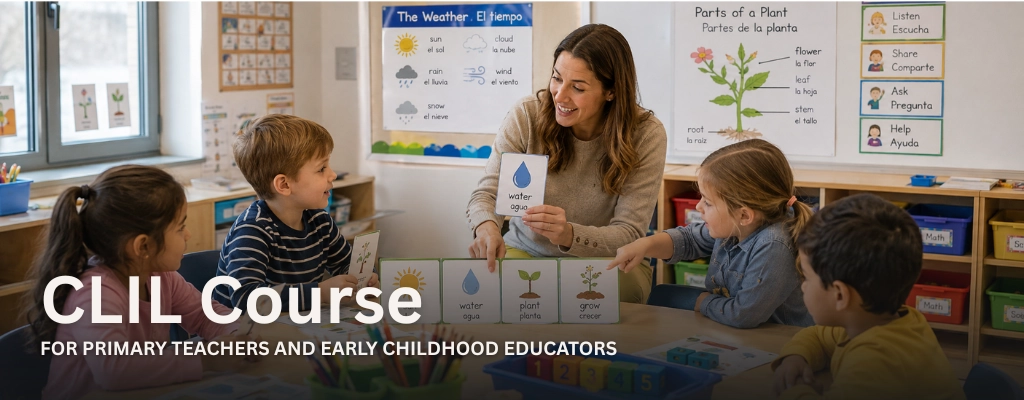
Our CLIL course for primary teachers and early childhood educators shows how to combine learning and language development through play, stories, routines and movement.
The course supports preschool, kindergarten, early years, and primary education staff in designing age-appropriate CLIL lessons that connect curriculum content with meaningful communication in a foreign or additional language.
Participants will explore how young children learn through repetition, imitation, sensory experience, social interaction, and predictable classroom routines. They will learn to plan content objectives and simple language objectives, select suitable picture books and realia, and use songs, games and creative tasks as CLIL resources.
The course also empowers educators to scaffold understanding with gestures, visuals, modelling, classroom language, sentence patterns, and supportive talk.
By the end of this CLIL course for primary teachers and early childhood educators, participants will have practical activities, adaptable materials, and a short CLIL learning sequence ready to use with young students.
The course will be adapted to participants’ age groups and curriculum areas.
Course Content
-
Principles of CLIL and early language learning for preschool, kindergarten, and primary education
-
Planning playful CLIL lessons with age-appropriate content objectives and language objectives
-
Using stories, songs, routines, games, movement, realia and creative tasks
-
Scaffolding comprehension and communication through visuals, gestures, modelling, repetition, and classroom language
-
Observing and assessing young learners in bilingual and multilingual settings
Learning Outcomes
At the end of the course delegates will be able to:
-
Understand how CLIL principles can be adapted to early childhood and primary education
-
Plan age-appropriate CLIL lessons with clear content and language objectives
-
Use stories, routines, songs, games, movement, and hands-on inquiry to integrate content and language
-
Apply multimodal scaffolding strategies that support comprehension, participation, and emerging language
-
Create inclusive classroom routines and interaction patterns for young multilingual learners
-
Use observation, documentation, and simple success criteria to assess content and language development
Assessment and Certificates
Assessment of performance will be through delegate-completed portfolio of work. The final course certification for successful completion is a college-issued “Course Certificate of Completion”, for each module studied. In addition, where applicable, delegates will receive relevant EuroPass certificates.