
Course Description
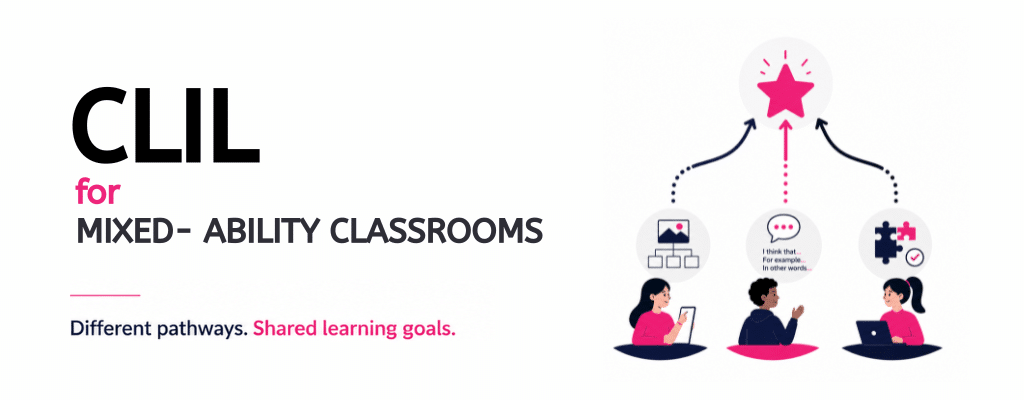
Our Erasmus+ KA1 CLIL teacher training course helps teachers design inclusive CLIL lessons for mixed-ability classrooms, where students have different language levels, prior knowledge, learning pace, confidence, strengths, and support needs.
The course supports teachers and education staff in maintaining shared, ambitious curriculum goals while providing different routes into a task, different forms of support, and meaningful options for participation and student production.
Participants will explore learner profiling, diagnostic and formative assessment, Universal Design for Learning principles, multilingual resources, flexible grouping, tiered tasks, choice and peer support. They will also learn to distinguish productive scaffolding from over-support.
The course empowers teachers to plan accessible input, structured interaction, manageable cognitive demand, and varied ways for learners to show understanding. These strategies help reduce participation barriers while preserving challenge and learner independence.
By the end of this course for mixed-ability classrooms, participants will have a CLIL lesson for mixed-ability classrooms ready to implement, a model adaptable for diverse classes in their school.
The course is suitable for primary and secondary CLIL teachers, subject and language teachers, inclusion staff, teaching assistants, and bilingual education teams working with heterogeneous or multilingual groups. The course will be adapted to the school profile and participants' needs.
Course Content
-
Understanding learner variability in language proficiency, readiness, prior knowledge, confidence, and learning needs
-
Using diagnostic and formative assessment to identify barriers, strengths, progress, and next steps
-
Planning accessible CLIL input, interaction, tasks, grouping, scaffolds, choice, and extension
-
Applying differentiation, Universal Design for Learning and peer-supported learning
-
Managing participation and assessing progress fairly across diverse learner profiles
Learning Outcomes
At the end of the course delegates will be able to:
- Use formative assessment to plan appropriate support and challenge
-
Design CLIL lessons with accessible input, multiple entry points, flexible grouping, and varied ways to respond
-
Apply tiered tasks, peer support and choice without fragmenting the class
-
Manage interaction and cognitive load in mixed-ability and mixed-language CLIL classrooms
-
Evaluate and improve lesson accessibility, challenge, learner agency, and assessment fairness
Assessment and Certificates
Assessment of performance will be through delegate-completed portfolio of work. The final course certification for successful completion is a college-issued “Course Certificate of Completion”, for each module studied. In addition, where applicable, delegates will receive relevant EuroPass certificates.