
Course Description
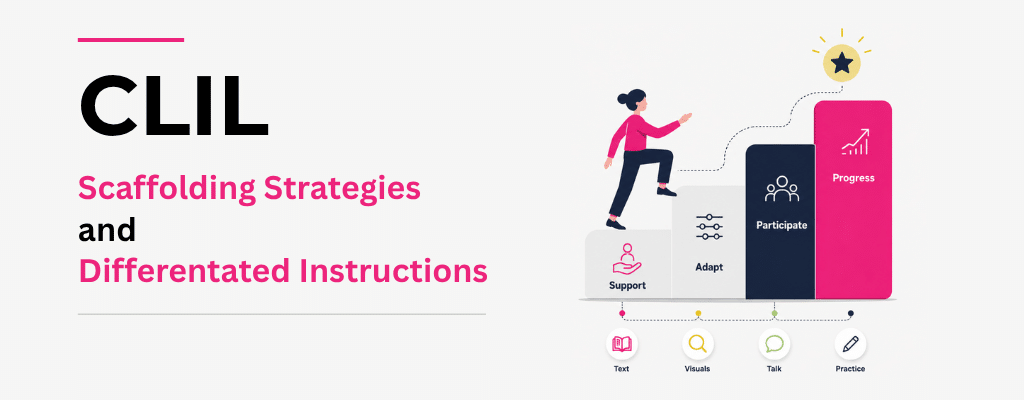
Our CLIL scaffolding course for teachers helps educators make subject content and academic language accessible to learners with different levels of readiness, language proficiency, confidence, and prior knowledge.
The course supports teachers in planning inclusive CLIL lessons with clear content objectives and language objectives, purposeful scaffolds, flexible grouping, multiple entry points, and appropriately challenging learning tasks.
Participants will explore how to scaffold vocabulary, texts, teacher talk, classroom interaction, thinking processes, and student production. They will also learn how to differentiate content, process, support, and expected outcomes without lowering curriculum expectations or creating a separate lesson for every learner.
The course empowers teachers to use modelling, visuals, graphic organisers, language frames, guided practice, tiered tasks, collaborative learning and formative assessment. These approaches help students participate more independently and demonstrate both subject understanding and language development.
By the end of this CLIL scaffolding course for teachers, participants will have practical solutions and an adaptable lesson plan for inclusive, language-rich teaching in multilingual and mixed-ability classrooms.
The course is suitable for primary and secondary CLIL teachers, subject teachers, language teachers, SEN and inclusion staff, and bilingual education teams. Activities will be adapted to participants’ subjects, age groups, and school contexts.
Course Content
-
Core principles of CLIL, scaffolding and differentiation
-
Planning content objectives, language objectives, success criteria, and multiple pathways to learning
-
Applying visual, linguistic, cognitive, interactional, and procedural scaffolds
-
Designing tiered tasks, flexible groups, accessible materials, and gradual release of support
-
Using formative assessment, feedback, and learner evidence to adjust support and challenge
Learning Outcomes
At the end of the course delegates will be able to:
-
Understand how scaffolding and differentiation support content and language learning in CLIL
-
Plan CLIL lessons with clear objectives, success criteria, multiple entry points, and flexible supports
-
Use practical scaffolding strategies
-
Differentiate tasks, materials, grouping, support, and outcomes while maintaining shared curriculum goals
-
Use formative assessment and feedback to fade, adapt, or extend support during learning
Assessment and Certificates
Assessment of performance will be through delegate-completed portfolio of work. The final course certification for successful completion is a college-issued “Course Certificate of Completion”, for each module studied. In addition, where applicable, delegates will receive relevant EuroPass certificates.