
Course Description
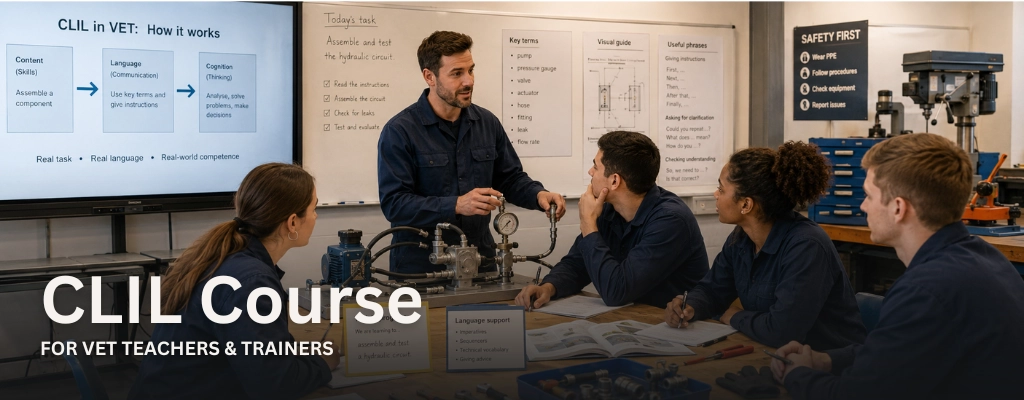
Our CLIL course for VET teachers helps vocational educators and trainers integrate occupational content, technical language, and workplace communication in practical, job-related learning.
The course supports vocational schools, technical colleges, training centres, and apprenticeship staff in designing CLIL lessons around authentic workplace tasks, tools, procedures, documents, safety requirements, and professional interactions.
Participants will learn to analyse the language demands of vocational competences, plan content objectives and language objectives, adapt authentic materials, and scaffold technical vocabulary, procedural language, reading, listening, and communication at work.
The course empowers educators to use demonstrations, problem-based learning, projects, digital resources, and collaboration with language teachers. This approach helps learners connect multilingual communication with employability, mobility, and safe professional practice.
By the end of this CLIL course for VET teachers, participants will have practical tools and a sector-specific CLIL module linked to vocational competences and real workplace performance.
The course is suitable for vocational subject teachers, technical teachers, language teachers in VET, workplace trainers, apprenticeship mentors, curriculum coordinators, and VET education staff. Activities will be adapted to the vocational sectors represented by participants.
Course Content
-
Principles of CLIL in vocational education, technical education, apprenticeships, and work-based learning
-
Analysing vocational competences, workplace communication, technical vocabulary, and safety language
-
Designing CLIL tasks with authentic materials, demonstrations, and problem-based learning
-
Scaffolding practical instructions, procedures, documentation, teamwork, customer communication, and learner confidence
-
Assessing vocational performance and language use through competency-based criteria
Learning Outcomes
At the end of the course delegates will be able to:
- Analyse the content and language demands of sector-specific competences and workplace tasks
-
Plan CLIL modules with vocational outcomes, language objectives, authentic materials, and realistic communication
-
Use demonstrations, visuals, language frames, simulations, and digital tools to scaffold technical learning
-
Design CLIL activities connected to employability and professional practice
-
Assess both vocational competence and language performance using clear, authentic criteria
Assessment and Certificates
Assessment of performance will be through delegate-completed portfolio of work. The final course certification for successful completion is a college-issued “Course Certificate of Completion”, for each module studied. In addition, where applicable, delegates will receive relevant EuroPass certificates.