Course Description
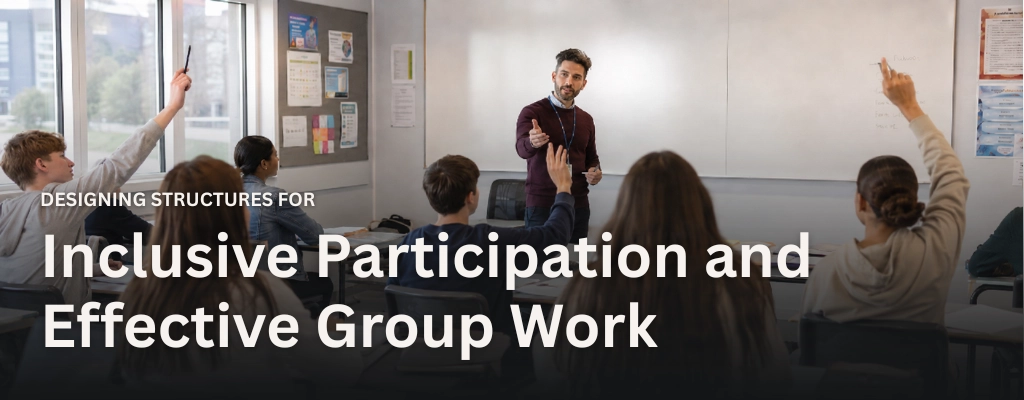
Our "Designing Structures for Inclusive Classroom Participation and Group Work" course helps teachers design clear discussion and group-work protocols and routines, turning discussion and group work into structured learning experiences in which every student has a fair and meaningful opportunity to contribute. It addresses familiar classroom challenges such as a small number of learners dominating talk, quieter students remaining invisible, uneven participation in groups, and activities that reward speed or confidence more than thoughtful engagement.
Teachers will explore and use inclusive and cooperative learning strategies, flexible grouping, peer tutoring, shared goals, success criteria, teacher monitoring and practical responses to conflict, domination, passivity and uneven effort.
The first part of the course empowers teachers to create activity structures and routines that encourage active engagement. Participants will examine and reshape classroom talk, wait time, turn-taking, and individual and shared accountability. The course will explore oral, written, visual and digital participation options, with particular attention to multilingual learners, hesitant speakers and students with different communication preferences.
The second part of the course focuses on making collaboration inclusive and accessible to diverse learners rather than allowing group work to reproduce exclusion. This helps students develop subject knowledge, communication, teamwork and a stronger sense of belonging.
By the end of this course, participants will have designed, tested and revised practical inclusive classroom participation protocols and structures in their own subject area that increase students' engagement and learning.
The course is suitable for primary and secondary teachers, vocational educators, facilitators and school staff seeking Erasmus+ training in student participation and group work. The course will be adapted to participant age groups and the sending institutions' contexts.
Course Content
-
Positive interdependence, individual accountability and inclusive peer learning
-
Group formation, purposeful roles, status awareness and flexible grouping
-
Cooperative tasks, shared goals, resources and transparent success criteria
-
Teacher monitoring, feedback, conflict response and balanced contribution
-
Lesson and activity redesign
-
Equitable participation, classroom talk and the purpose of structured protocols
-
Flexible oral, written, visual and digital participation channels
Learning Outcomes
At the end of the course delegates will be able to:
-
Recognise patterns of domination, silence and unequal participation
-
Design respectful discussion norms and turn-taking structures
-
Create group roles that support meaningful and balanced contribution
-
Offer flexible participation options for different communication needs
-
Observe and evaluate participation using simple evidence tools
-
Develop and refine a protocol for inclusive discussion or group work
-
Design tasks that require positive interdependence and individual accountability
-
Create a complete cooperative learning lesson for classroom use
Assessment and Certificates
Assessment of performance will be through delegate-completed portfolio of work. The final course certification for successful completion is a college-issued “Course Certificate of Completion”, for each module studied. In addition, where applicable, delegates will receive relevant EuroPass certificates.