
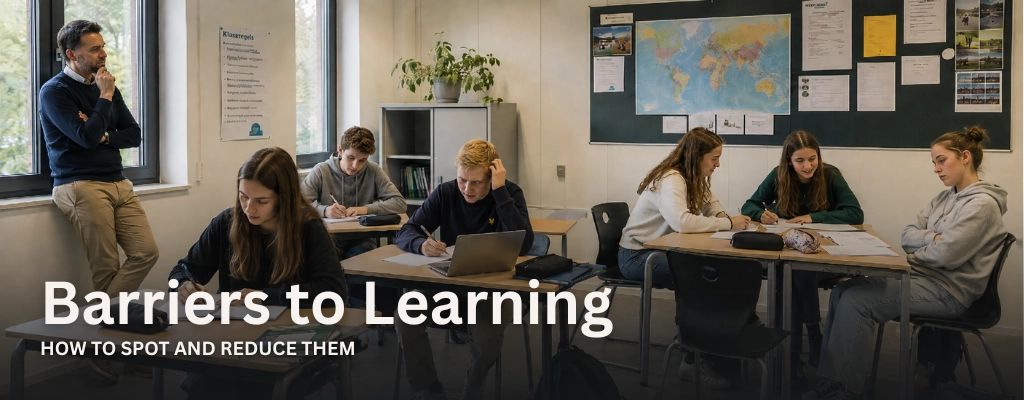
Course Description
Our Erasmus+ teacher training is a practical course that helps teachers reduce barriers to learning. It provides a practical framework for recognising and reducing the conditions that limit student access, participation, engagement and progress.
The course supports teachers and education staff in examining instructional, environmental, linguistic, social, emotional and attitudinal barriers across lesson materials, classroom tasks, routines and relationships.
Participants will explore how to distinguish essential learning demands from avoidable difficulty, review accessible teaching materials, redesign rigid tasks and use learner voice to understand classroom barriers more accurately.
The course empowers teachers to prioritise realistic changes with the greatest likely impact. By the end of this course, participants will have learned how to recognise and reduce barriers to learning, as well as implement strategies for a more inclusive and participatory classroom.
The course is suitable for primary and secondary teachers, special education staff, school leaders, counsellors and professionals seeking Erasmus+ inclusive education training. Activities will be adapted to participant subjects and learning environments.
Course Content
-
Environmental, instructional, linguistic, social and attitudinal learning barriers
-
Accessibility, language, representation and format in lesson materials
-
Hidden demands, rigid instructions and unnecessary difficulty in classroom tasks
-
Belonging, trust, emotional safety and classroom climate impacting students' participation
-
Redesign strategies and implementation planning
Learning Outcomes
At the end of the course delegates will be able to:
-
Identify different categories of barriers to learning and participation
-
Review teaching resources for accessibility, clarity and representation
-
Recognise social and emotional conditions that restrict participation
-
Redesign a lesson activity to remove unnecessary barriers
-
Create a practical barrier-reduction plan
Assessment and Certificates
Assessment of performance will be through delegate-completed portfolio of work. The final course certification for successful completion is a college-issued “Course Certificate of Completion”, for each module studied. In addition, where applicable, delegates will receive relevant EuroPass certificates.