
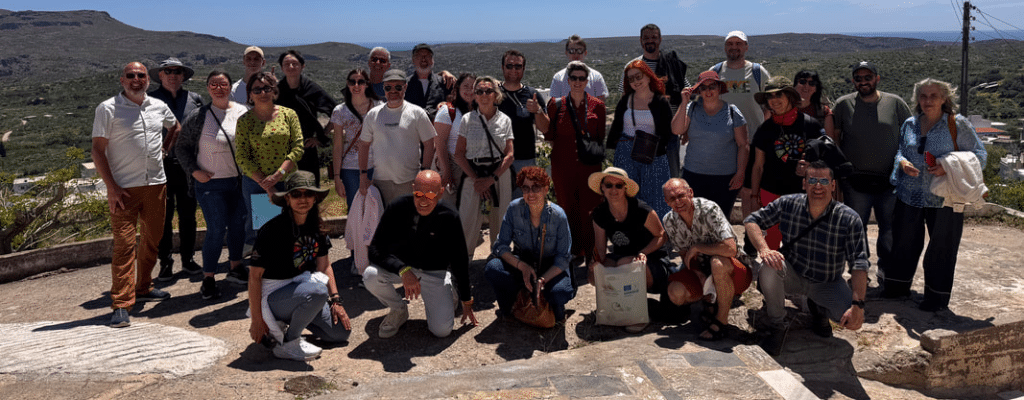
From 28 April to 1 May 2026, we flew to Sitia (Crete, Greece) to explore practical examples of outdoor learning for teachers with our European partners for the first teacher mobility of the GreenSTEAM project.
Through school visits, field trips and cultural activities, teachers from Ireland, Iceland, Greece, Croatia, Czech Republic, Italy and Poland learned how natural environments, cultural heritage and education can be meaningfully connected.

About The Project
The Erasmus+ KA220 Green STEAM school project aims at empowering schools to become active agents of climate literacy. It combines field-based research for students, environmental sensors in education, and digital storytelling for climate action. By combining science, technology and mobilities, it connects global climate challenges with local realities, strengthening data literacy for European students.

Day 1 – School Visit and Cultural Learning
The mobility opened with a visit to the 3rd Primary School of Sitia. Students welcomed participants through songs, dance and local traditions, highlighting how cultural heritage and the arts can become a meaningful part of environmental education. Later in the day, we took part in field visits to Toplou Monastery and Vai.

Day 2 – Sitia UNESCO Global Geopark and Outdoor Learning
The second day focused on the Sitia UNESCO Global Geopark. In Zakros, partners explored how geological heritage, biodiversity, cultural history and sustainability can be combined in interdisciplinary learning.
Here we tested activities with tablets and sensors, which demonstrated how digital tools can support outdoor learning. This reflects the same practical approach we explore in our “Outdoor Learning and ICT” training course, where teachers learn how to connect fieldwork, technology and place-based learning.

Day 3 – Heritage, Identity and Local Narratives
On the third day, we went on a guided tour of Sitia. The visits reinforced the importance of creating learning activities that are locally relevant, while still being transferable across partner countries.

Day 4 – Reflection and Farewell
The mobility ended with a final project meeting, where partners reviewed the learning from the week. Discussions focused on how these experiences could be translated into practical lesson plans and outputs for use in different contexts.

Next Steps
The next phase of the project will focus on developing and testing lesson plans with local schools. These materials will support educators in bringing environmental topics to life through fieldwork, digital tools, creative outputs and community-based learning.
The next fully-funded teacher mobility will take place in October 2026. It will offer another opportunity for teachers and education professionals to explore innovative approaches to sustainability education and international collaboration.
If you’re an Irish teacher or educator interested in taking part in the project or the October mobility, reach out to us! We will provide you with more information on how to join.
If you’re interested in learning more about the outdoor learning for teachers, digital tools and AI-supported education and creative learning, browser our list of upskilling training courses and get in touch.

SIGN UP NOW!
Follow our Facebook Page and Instagram Profile for all project updates, related activities and materials.