
Erasmus+ training courses are professional development opportunities funded through the European Union’s Erasmus+ Programme. They allow teachers, trainers, and education staff to learn new skills, exchange good practices, and gain international experience through structured learning activities abroad.
This blog guides you through the most Frequently Asked Questions for teachers who are new to the programme, including:
- What Is an Erasmus+ Training Course?
- Who Can Participate in Erasmus+ Training Courses?
- How Do Erasmus+ Training Courses Work?
- Are Erasmus+ Training Courses Accredited?
- What is the cost of Erasmus+ Training Courses?
- How to Choose the Right Erasmus+ Training Course?
- Where to Find Erasmus+ Training Courses?
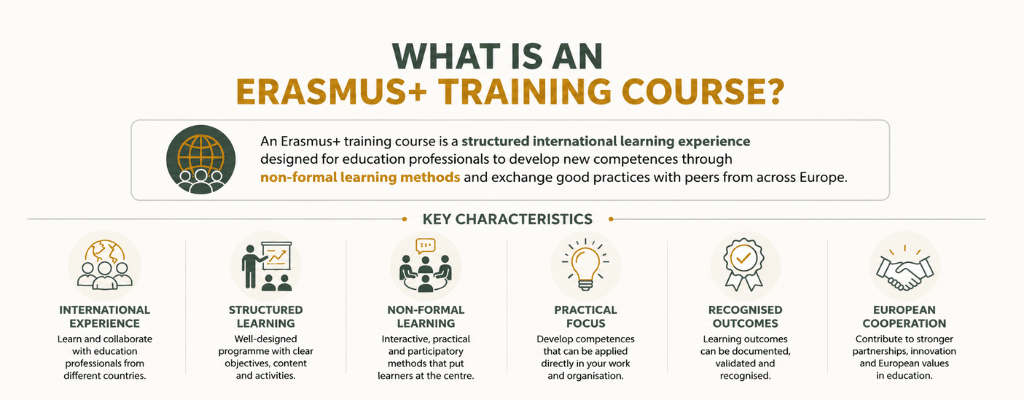
What Is an Erasmus+ Training Course?
An Erasmus+ training course is a structured learning activity that takes place within the framework of an Erasmus+ mobility project. The courses take place in a European country and focus on specific competences for teachers and staff in schools, VET and adult education institutions.
Training courses usually address highly relevant topics to address current educational challenges such as:
- AI and digital education
- Inclusive teaching
- Sustainability and green practices
- Leadership and management
- Language learning
- Active and student-centred methodologies for students’ engagement
- Intercultural teaching and learning
The overall goal is to support lifelong learning and improve the quality of education throughout Europe.
Who Can Participate in Erasmus+ Training Courses?
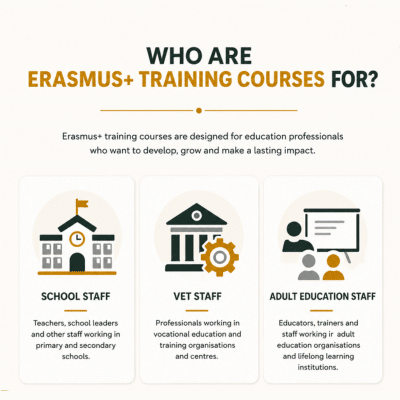
Erasmus+ training courses are available to professionals working in different educational sectors in Europe.
Eligible participants may include:
- Teachers and educators
- School leaders and headteachers
- SEN teachers
- Non-teaching staff working in schools or education organisations
- Trainers and facilitators
- Vocational education and training (VET) professionals
- Adult education staff
Participation is normally organised through an institution that has received Erasmus+ funding for staff mobility and professional development activities.
From 2027, the UK will rejoin the Erasmus+ Programme. This opens up Erasmus+ opportunities for British teachers, as well as UK Erasmus+ training courses for European teachers.
How Do Erasmus+ Training Courses Work?
Most Erasmus+ training courses are organised as part of staff mobility projects funded under Erasmus+ Key Action 1 (KA1).
In practice, participants travel to another country to attend a training activity delivered by a host organisation. The duration of the training varies according to the provider and the funding each institution has available, and it usually ranges from 5 to 10 days.
The purpose of these courses is not only to provide new knowledge but also to support participants in applying what they learn within their own institutions and communities.

This is why Erasmus+ training courses are generally based on non-formal learning methodologies. They usually combine:
- Exchange of good practice
- Expert input and facilitation
- Interactive workshops
- Group discussions
- Collaborative learning activities
- Practical exercises
- Reflection sessions
This is one of the key strengths of Erasmus+ training courses. Learning does not come only from trainers, but also from the diverse experiences and expertise of fellow participants across Europe.
Are Erasmus+ Training Courses Accredited?
Despite being non-formal, the knowledge, skills and competences acquired during an Erasmus+ training course can be documented and recognised by participants’ institutions.
Participants usually receive certificates of attendance or the Europass certificate describing clear educational objectives and professional practice. These can support professional development and lifelong learning pathways.

What is the cost of Erasmus+ Training Courses?
Each training provider sets a specific price for their training courses. Many providers also offer additional packages, adding excursions to their schedule.
The good news is that participants can attend these mobilities through the Erasmus+ funding. This is generally awarded to institutions rather than individuals. They apply for Erasmus+ mobility funding and then select participants for training activities.

Depending on the approved project and applicable funding rules, support may contribute to:
- Travel expenses
- Accommodation costs
- Individual support during mobility
- Course fees
The specific funding available depends on the project type, country, and annual Erasmus+ programme rules.
How to Choose the Right Erasmus+ Training Course?
When selecting a course, you should go beyond the Erasmus teacher training course catalogue of your selected provider It’s important to consider the following factors:
- Clear educational learning objectives
- Course quality
- Relevance to European priorities
- Practical application
To help you evaluate courses more effectively, we have prepared a detailed guide covering the indicators of a high-quality Erasmus+ learning experience.
Where to Find Erasmus+ Training Courses and What are the Platforms to Find Erasmus+ Course Providers?
Once you have identified your professional development needs, the next step is finding a suitable Erasmus+ training course provider.
Today, most Erasmus+ training opportunities can be found online. Because there are hundreds of organisations offering Erasmus+ training courses across Europe, choosing the right provider can sometimes feel overwhelming. You can read more tips on our detailed guide explaining where to find Erasmus+ course providers.
More questions?
If you have more questions or want to take part in a training course, reach out to us!
At HESL, we design Erasmus+ training experiences that combine practical learning, international collaboration, and real-world application.

Our courses are developed for teachers and education staff who want to strengthen their skills while engaging with colleagues from across Europe. Through interactive workshops, collaborative activities, and expert facilitation, participants gain knowledge that can be directly applied in their organisations and communities.
Browse our course catalogue and contact us to learn more, receive guidance on the best training course to choose for your needs and apply for your session!